
Revisiting the Islamic Movement-Fatah 1983 Clash at the Islamic University of Gaza and Commander Maysara Ahmed Mohammed Abu Hamdiya: An Analysis of the History of Fatah-Hamas Enmity and Amity
by Mujamma Haraket
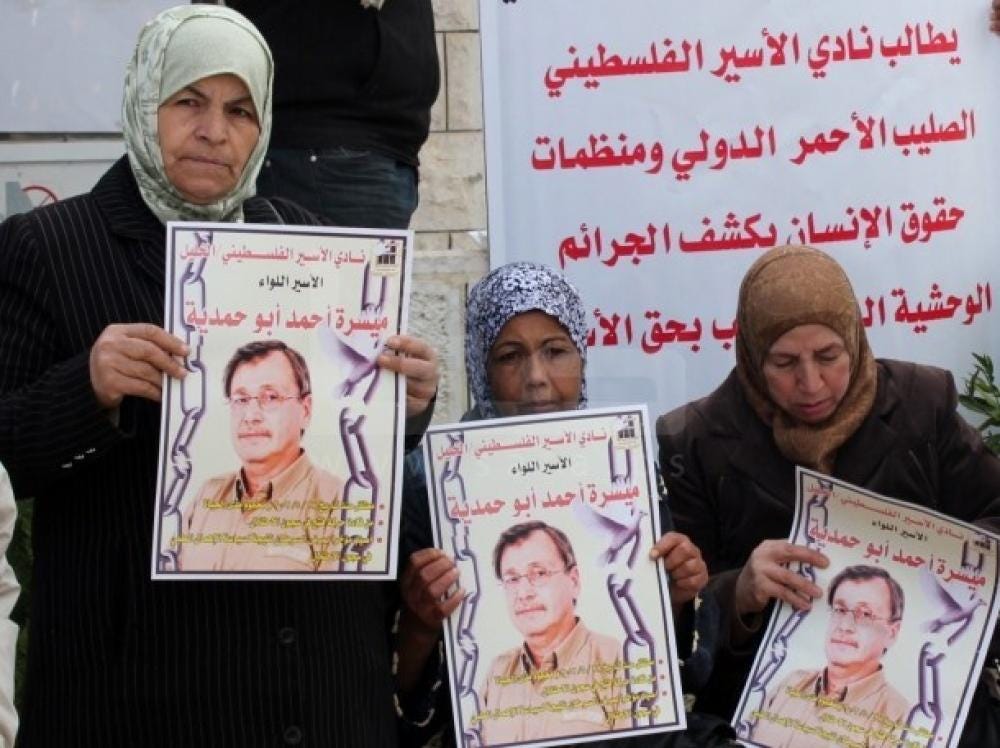
Photos of the martyred commander, Maysara Abu Hamdiya
Introduction
This article reviews the historical conditions behind the May 1983 Islamic Movement-Fatah clash—which, alongside a confrontation the previous year, broadly inaugurated the enmity that has consequently marred Fatah-Hamas relations—to complicate the received view that the Fatah-Islamic Movement enmity is anchored in ideological differences. A close review of the conditions behind the clash reveals that it was due to a struggle for power rather than ideology. This article then considers the case of Fatah commander Maysara Ahmed Mohammed Abu Hamdiya who trained Hamas resistance fighters in the late 1980s to further challenge this narrative. It concludes by analyzing how this history proves relevant in the face of the Palestinian Authority’s recent practices of prohibiting Hamas, Hamas-backed lists, and the Islamic bloc from participating in professional, union, and municipal elections (with these lists proving electorally successful where competitive elections have been permitted).
1. The May 1983 Fatah-Islamic Movement Clash at the Islamic University of Gaza
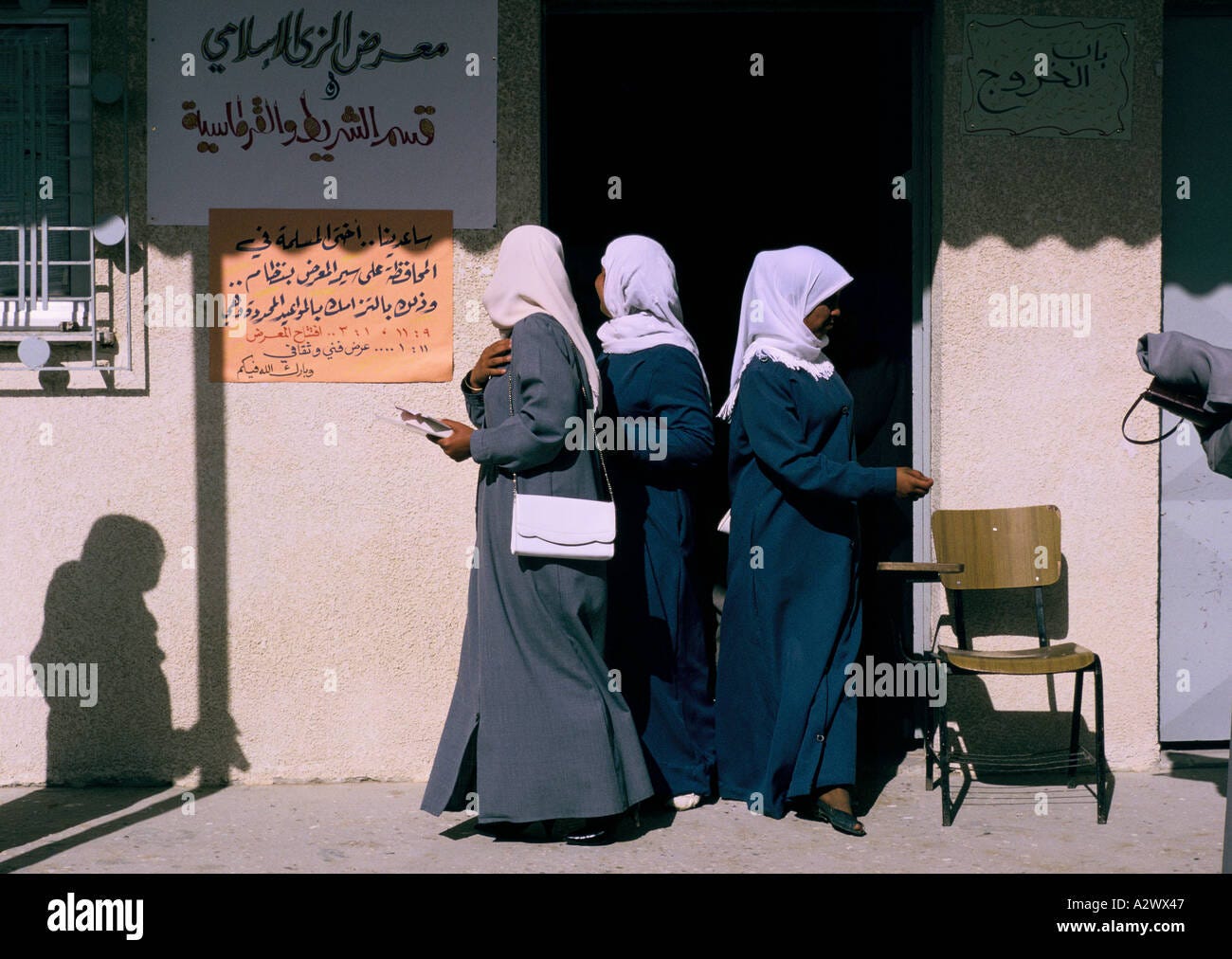
Female students at the islamic university of Gaza, Israeli Occupied Territories, n.d.
It is often thought that Fatah and the Islamic Movement univocally enjoy inimical relations and that this is by dint of their dichotomous ideologies: that the former is a secularist organization and the latter an Islamist one, resulting in an intractable chasm. This narrative has been cemented in the aftermath of post-Summer 2007 developments, where Hamas assumed governance of Gaza following the Palestinian Authority’s attempt, working with United States Army General Keith Dayton and the George W. Bush regime, to stage a coup to topple the Hamas-majority Palestinian Legislative Council.[1] However, the history of antagonism well precedes the 1987 formation of Hamas.
One of the earliest formative incidents that found the two groups at odds is the 31 May 1983 clash at the Islamic University of Gaza (IUG). IUG had been founded in 1978, with the Palestinian Muslim Brotherhood taking the initiative; though, during its first five years and as the first university in Gaza, few of its instructors held higher education degrees; come 1983, IUG underwent a shift in faculty appointments so as to render the institution a more academically rigorous establishment. This foregrounds why the student Islamic Bloc, al-Kutlah al-Islamiyyah, and the pro-Fatah student organization, al-Shabiba, clashed that year. This clash was a momentous occasion, as it was also the first instance in which Fatah,[2] via its then paper of record, al-Fajr, birthed the now decades-long myth that the Islamic Movement “collaborated” with the Zionist occupation, laying the groundwork for this narrative, which Fatah members ranging from Yasser Arafat to Mohammed Dahlan would continue to reify in the face of an ever-burgeoning Islamic Movement.[3]
However, the tensions were more circumscribed during this period. In 1983, Arafat, alongside the IUG Committee and Board, decided to appoint Muhammad Saqr—a Jordanian Muslim Brotherhood member with a doctorate from Harvard—as President, replacing the incumbent, Riad al-Agha, who had served only in an acting capacity due to his insufficient qualifications.[4] As indicated above, during this period, Gaza faced a shortage of adequately qualified academics, and, as IUG Dean Abu Sibah indicated, this scarcity precipitated the recruitment of thirty-two doctorate-holding lecturers from Jordan.[5] Many had ties to the Jordan Muslim Brotherhood, an organization which emphasized erudition and study. Prior to this (and based on the figures provided by the Statistical Bulletin for West Bank with a with a six with a the Gaza Strip), the first Dean of Sharia, Abu Sibah, only had Bachelor’s degree and, during its first year of operations, lUG had but one lecturer with a doctorate, five with Master’s degrees and six, with Bachelor’s degrees; by 1983, there were four professors with Doctorates, nine with Master’s degrees, and nineteen with Bachelor’s degrees. It was anticipated that the arrival of the new appointees in Gaza would create disparities in pay between local and foreign staff, as the newly onboarded professors were, due to their higher qualifications, set to receive a greater salary. A portion of the extant staff, who were associated with the PLO, were riled.
These worries were not only limited to the staff. PLO student activists also expressed worries about the onboarding of President Saqr and the Jordanian academic recruits. The received view in the existing scholarship was that the PLO student activists’ worry centered on the possibility that the new appointees would displace PLO loyalists and also expand the ranks of Islamically inclined personnel, thereby securing the Islamic character of the IUG. This may indeed have been a worry for some of the PLO-associated flank, though Jeroen Gunning’s 1998 survey of students from the Fatah-dominated al-Azhar University in Gaza demonstrates that, within its rank and file, a majority of PFLP and Fatah students preferred an Islamic-oriented political state.[6] The survey, reproduced below, is quite revealing:
Of 398 Azhar students who stated they nationally supported Fatah, 53% said they hoped to see an Islamic state in Palestine, 28.4% a mixed Islamic-secular state (this term, familiar to students, indicates that Islam should have some official role in state structures). Of the 14 who put their trust in the (leftist) PFLP, the figures are 57.1%, 7.1%, 21.4%. Overall, 74.5% of 526 Azhar students answering the question ‘To what extent should religion have influence over politics?’ replied 70% or over (35% stating 100%).
Although this survey was conducted approximately 15 years later, there is no indication that the PLO experienced de-secularization in this period. Furthermore, a separate survey, conducted in 1982, found that all Muslim student respondents in Gaza—be they associated with Fatah, PFLP, DFLP, or the Islamic Movement— strictly adhered to Islamic practices.[7] Additionally, 78% of female respondents reported choosing to wear the hijāb (headscarf) without pressure from their families. The claim that Fatah was a secular organization is rather dubious. Firstly, many of its formative figures were members of the Muslim Brotherhood. As Mohsen Saleh writes, reflecting on Fatah’s 1957 formation in Kuwait:
Khalil al-Wazir (aka Abu Jihad) […] was a member of the MB [viz., Muslim Brotherhood], and […] became the number two man in Fatah for 30 years […] [and] suggested the move to the MB leadership in GS [Gaza Strio], but to no avail. However, this did not stop a considerable number of prominent and respected members of the MB from joining Fatah upon its foundation, such as Sa‘id al-Muzayyan, Ghalib al-Wazir, Salim al-Za‘nun, Salah Khalaf, As‘ad al-Saftawi, Muhammad Yusuf al-Najjar, Kamal ‘Adwan, Rafi al-Natshah, ‘Abdul Fatah Hammoud, and Yusuf ‘Umairah. They all assumed senior leadership positions in the movement. In addition, Yasir ‘Arafat himself was close to the MB movement.[8]
Secondly, as evidenced by the statement Fatah produced in its third congress, the organization, “refrained from calling it[self] secular”;[9] it instead decreed itself “[a] democratic, progressive, nonsectarian state in which Jews, Christians and Muslims would live together in peace and enjoy the same rights.”[10] Arafat expressly claimed that the movement did not seek the “establishment of a secular state,” but rather a democracy.[11] This would indicate that the enmity with the Islamic Movement was not entirely ideological and that the struggle for power may have greatly influenced the rhetoric proffered.
As Gunning indicates, the internal tensions also unfolded alongside broader strains between the PLO’s external leadership and local activists.[12] After his defeat in Beirut in 1982 and the introduction of the Reagan Plan, which proposed a Jordanian-Palestinian confederation, Arafat began more actively considering whether Jordan might represent the Palestinians in U.S.-sponsored negotiations with the occupation, a direction strongly opposed by several PLO factions, including the PFLP and many Fatah activists in the territories. At the same time, rumors circulated that King Hussein was intervening in Gaza through the IUG, much as he was alleged to be using the awqāf institutions in the West Bank to expand his influence at the PLO’s expense. Because the Islamic Movement was widely viewed as supporting Hussein—mirroring the perceived closeness of the Jordanian Muslim Brotherhood to the monarchy—and because Saqr himself was a member of the Jordanian Ikhwan, internal PLO tensions were readily mapped onto the struggle with the Islamic Movement. Arafat’s attempted rapprochement with King Hussein, coupled with his deteriorating relationship with Syria following its role in his expulsion from Lebanon, prompted Arafat to attempt to grow closer to the Islamic Movement during this period, further complicating the situation.
Some local activists within the PLO resented Arafat’s cooperation with the Palestinian Muslim Brotherhood and particularly objected to his engagement with the politically conservative Sheikh Muhammad Awwad. It bears noting here that, although Awwad was indeed a member of the Palestinian Muslim Brotherhood, he occupied a flank opposed to that led by Sheikh Ahmed Yassin. Yassin’s faction was known as the “Mujamma,”[13] named after the al-Mujamma’ al-Islami civil services institution that he founded. While both Awwad and Yassin were part of the efforts to create IUG, they and their distinct factions of the Palestinian Muslim Brotherhood butted heads during this process. Beverly Milton-Edwards’ influential 1996 study misrepresents the internal structure of the Palestinian Muslim Brotherhood by overlooking that it included factions opposed to Yassin and the Mujamma—that is, to the apparatus that would, in the wake of the First Intifada, become Hamas. Milton-Edwards mistakenly chronicles that:
[The] Mujama strategy had many facets […] Mujama supporters like Sheikh Mohammad Awwad were reportedly further incensed by the rumour that […] the nationalists were going to establish their own university in Gaza. It was reported that by this point Sheikh Awwad and his colleagues ‘felt more and more like a besieged fortress of righteousness in a sea of iniquity’. Thus, on 7 January 1980, Sheikh Awwad and his Mujama supporters called a meeting at the Islamic University to discuss the nationalists’ activities.[14]
However, Awwad was not a member of the Mujamma. In fact, he lobbied authorities against “the creation of the Mujamma,” going so far as to advise the occupying “Israeli authorities against granting it a permit, and only enlisted its help to safeguard the Islamicity of the University.”[15]
Returning to the IUG clash, it is true that Arafat had been exhorted by Abu Jihad to warm up to Awwad during the early 1980s, which vexed some of the rank and file within both Fatah and PFLP. The relationship became more amiable as Abu Jihad, Arafat, Awwad and others in IUG’s Founding Board of Trustees and Committee of Founders in Jordan—including those both associated with Fatah and the Islamic movement—worked together to raise funds.[16] It should be noted, however, that the PLO’s amicable relationship with the Islamic Movement did not necessarily extend the Mujamma flank.
Within this context, mired by acrimony, PFLP-affiliated students, working alongside affiliated staff, appear to have sought to reverse Dr. Saqr’s presidential appointment and reinstate the former acting President, Riad al-Agha. Although al-Agha had initially agreed to the arrangement, he soon resisted accepting a diminished role in the university. Despite not being politically aligned with either camp, he instrumentally sided with Fatah’s al-Shabiba bloc hoping it would allow him to remain in office. According to Gunning, some accounts even claimed that Riad al-Agha “deliberately appointed” those associated with al-Shabiba to administrator positions at the IUG during this short period so as to bolster his ranks.[17]
Concurrently, a group of university employees associated with the Fatah bloc created a new university union on 10 May. A significant number of IUG workers, unassociated union members, and student organization activists (particularly associated with the opposed al-Kutlah al-Islamiyyah) decried the decision. But a strike was planned nevertheless. It was nominally centered on how salaries were to be determined moving forward, but the subtending issue was the appointment of more accredited professors—as this was the cause for the impending pay differential. It is highly significant that the Zionist occupation instrumentalized the heightening tensions. As then Dean of Student Affairs, Abu ‘Ali recounted, the occupation began distributing “inflammatory leaflets”; as the former Dean reflected:
The occupation was playing on contradictions [between the two parties] ... [A] small group of agents [published] a leaflet on this or that. ... [S]itting in my office ... one [of the two parties] would say: there was a leaflet against us. The other would say: we didn’t sign it. This happened on many occasions. They praised me as a reconciler; I didn’t reconcile, I only clarified that neither was responsible for the conflict.[18]
The two-week strike came to a bloody apotheosis on 31 May 1983. That day, the clash between pro-Fatah students and the Islamic Movement’s student bloc transpired outside the IUG. 300 students from the West Bank (specifically, from Bir Zeit, Najah and Bethlehem) were bussed into Gaza by al-Shabiba to serve as a support flank for the pro-PLO side. The strike organized by the pro-PLO factions thundered in the background; the strike also included members affiliated with the PFLP’s Jabhah al-’Amal al-Tulabiyyah student organization. According to Ismail Haniyeh, who was involved with the Islamic Movement’s student bloc at the time, some of the opposing strikers “threatened some of the University professors who wished to continue with the exams, regardless of the strike […] [and] many of them were seriously hurt. Nail Abu ‘Ali was one of the professors who was threatened.”[19]
Hamas member and movement philosopher Ismail Abu Shanab, who also was a member of the Islamic student bloc at this point, recalls that:
The Islamic University announced that it wanted to bring in a new professor to be the President ... [T]he Fatah people and the communist parties said [to each other]: we reject this professor and plan to attack ..., remove this person, and control the university. This plan was decided in Bir Zeit University. And from Bir Zeit came students, from Fatah and the communist parties. They gathered at Beit Hanun [north of Gaza City], that night, and the Mujamma‘ party noticed ... people coming from outside were gathering in Beit Hanun to attack the university. So what do you expect their reaction will be? To defend the university. So they urged their supporters to gather around the university, to defend it against any attack – if it comes. In the morning, those who had planned the attack, came directly to the university, expecting everything to be open ... because they did not know that the Mujamma‘ had noticed their movement. So all of a sudden clashes erupted. In any clash, you use whatever you have. We didn’t have guns, and thank God we didn’t have guns at that time. So with stones, sticks, whatever they could find as hand tools, they defended. ... From that moment, they [Fatah and the communists] began to say: they attacked us, they did this and that. Yes, we did. It’s not shameful to do so because you are coming to attack the university. So we defended the university.[20]
After the bussed students exited, a physical brawl transpired. It is unclear who started the brawl, with both sides blaming the other. According to a witness account, the Islamic Bloc injured fifteen students and teachers associated with the PLO wing; according to another, there were a total of 70 injuries with “600-900 people fighting,” on both sides.[21] During the brawl, Zionist occupation soldiers further instrumentalized the collision, circumscribing the perimeter of the campus. When students tried to flee the clashes, the soldiers prevented them from doing so. According to former Dean Abu ‘Ali, an interior office minister referred to as “Dahan” even tried to exacerbate the fighting by “hand[ing] out weapons.”[22]
The fighting subsided, but the next day, 1 June 1983, a group of Fatah bloc students hurled a hand grenade at the newly appointed president Saqr’s home. While his windows were shattered, this did not cause any bodily injuries. Following these incidents, Fatah’s al-Fajr paper reported that IUG “took our front page ads calling the incident ‘part of a low conspiracy’ aimed at crippling the [academic] ‘progress of the university.”[23] Although it could not be demonstratively evidenced, the widespread view was that it was a group of al-Shabiba students who had launched the grenade. This speculation was bolstered by the fact that PLO activists at Najah University in Nablus had organized a strike and violently assaulted students associated with the Islamic Bloc (al-Kutlah al-Islamiyyah) the previous year (i.e., 1982) in protest of the latter’s winning student elections. On 4 June, three days after the targeting of Saqr’s home, another, albeit smaller, fight took place between al-Shabiba and al-Kutlah outside of Bir Zeit University.
Despite al-Shabiba’s best efforts, the appointment of Saqr as president of IUG was successful. As indicated above, the 1983 collision and the Fatah bloc’s failed efforts to prevent Saqr’s appointment augured a new conspiracy; Fatah’s al-Fajr newspaper wrote:
Anti-national Muslim fanatic students with outside supporters launched attacks, June 4, on students at Bir Zeit University ... and the Islamic University of Gaza, injuring more than 70 students and causing extensive property damage. [...]
Fights began at the Islamic University at around 8:00 am when groups belonging to the Islamic bloc in Gaza infiltrated through the forest area and onto the campus. A car full of Muslim Brothers was driven tank-like into the cafeteria ... They then ... attacked other students with rods, clubs, shovels and knives. The campus and surrounding streets were transformed into a battle ground with hundreds of students participating.
[...] A mobile medical unit belonging to the Islamic Institute accompanied the attackers [...]
At Bir Zeit, three hours after the fighting in Gaza had quietened, two busloads of Islamic bloc supporters arrived from Gaza ... Eye-witnesses estimated 100 young men and women tried to enter the old campus ..., claiming they wanted to march on campus on the occasion of the 16ᵗʰ anniversary of the start of the occupation. The doorkeeper and students tried to stop them entering but were beaten and pushed aside. [...]
[...] [S]cores of local students climbed onto roofs and sent down a shower of stones, forcing the group to disperse. ... the rest fled back to the mosque and started chanting slogans against “infidels”, “communists” [...]
The organised Islamic students involved in the clashes at both universities are known in the occupied territories as Ikhwan Muslimin [Muslim Brothers] ... The Ikhwan have taken an increasingly active political role, frankly anti-nationalist, in recent years leading Palestinians in the West Bank and Gaza to consider them collaborators with the Israeli authorities.¹²
This tendentious rendering is rife with misrepresentations and outright fictions, with the most significant being that the Islamic Movement members were considered “collaborators” by the Palestinian people. There was also no car driven through a cafeteria nor a “mobile medical unit” assisting the Kutlah’s side. These fabrications were likely intended to besmirch the Islamic Movement’s reputation, with the claim concerning the “medical unit” implicitly targeting the Mujamma’s al-Jam`iyyah al-Islam’iyyah institution, which, following its 1976 establishment, had been regularly providing medical services to the downtrodden via mobile units. One might very well speculate that the Fatah movement sought to use these fabrications to inspire odium against the Islamic Movement and halt the Mujamma’s escalating political power.
In many ways, al-Fajr’s inaugural claim concerning “collaborators” has colored the subsequent history of the Islamic Movement’s relationship with Fatah. This narrative was propagated and popularized by Mohammed Dahlan, three years later in an IUG courtyard debate with Yahya al-Sinwar.[24] In the early 1990s, as Fatah began the Madrid-Oslo process, Hamas formed the Ten Resistance Organizations (TRO), working with various political parties, including nationalist and Marxist/Communist parties similarly opposed to the so-called “peace process.”[25] For Fatah, the TRO threatened to displace the PLO; the myth hence became a cudgel recited by Fatah members.[26] However, there are notable exceptions to this antagonism, including instances of members of the Palestinian Authority’s Security Service and War Room assisting Hamas resistance fighter and engineer Dr. Ibrahim al-Maqadma in counterintelligence gathering during the mid-2000s.[27] One prominent figure that has hitherto been overlooked in much of the extant Hamas scholarship concerns Maysara Ahmed Mohammed Abu Hamdiya. This case study is particularly illustrative as Abu Hamdiya was determinative in the training of the Izz al-Din al-Qassam Brigades.
2. Maysara Ahmed Mohammed Abu Hamdiya
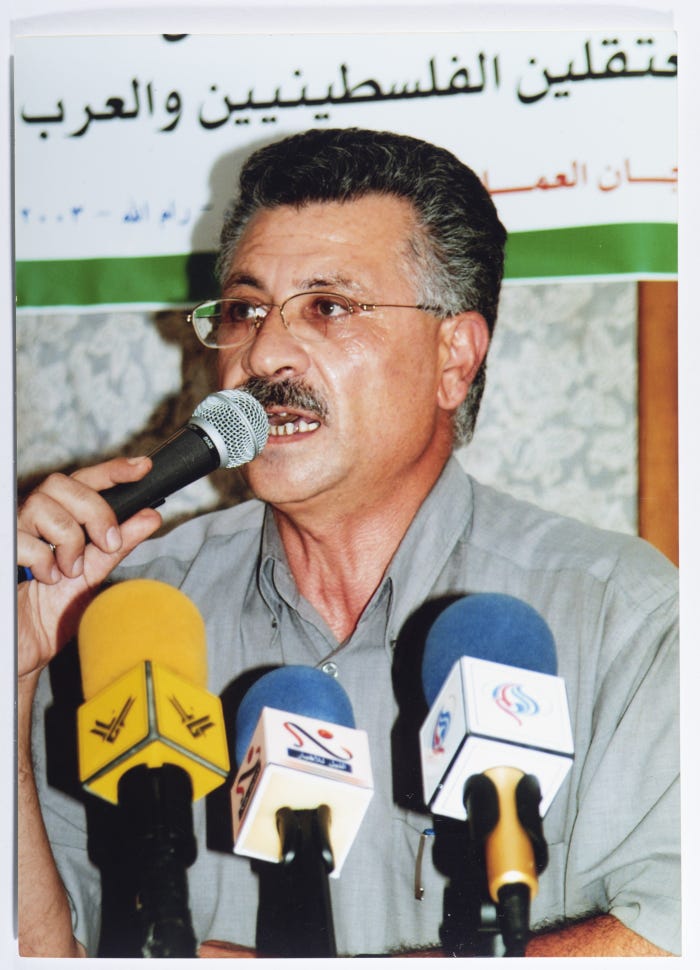
A color photograph of Abu Hamdiya speaking at the the Third Annual Media Competition of the Health Work Committees entitled “The Health Conditions of Palestinian and Arab Detainees.” Date created: 2003. The Ahmad Maslamani Collection.
Maysara Ahmed Mohammed Abu Hamdiya (“Abu Tariq”; b. 1948 – d. 2013) hailed from the city of Hebron in the southern occupied West Bank and was one of its earliest fighters. He became a shahid while incarcerated in the Zionist occupation system (Soroka Hospital from Eshel Prison), where he spent the last eleven years of his life suffering from throat cancer. Abu Hamdiya was married and had four children. He held a diploma in electronics from Cairo and enrolled in the Faculty of Law at the University of Beirut, but was unable to complete his studies there due to persecution and arrest.[28] During his incarceration, he studied history by correspondence at Al-Aqsa University in Gaza. He began his resistance work in 1968 and was arrested on charges of belonging to the Union of Palestinian Students in 1969. He was also arrested several times between 1969 and 1975, and in the years 1970 and 1975, he moved between Kuwait, Syria, Lebanon, and Jordan. He was placed under administrative detention each time he intermittently returned to the West Bank. He served in Lebanon as a fighter in the al-Jarmaq Battalion (the Student Battalion). He was arrested in 1976 and remained in administrative detention until 1978. He was then transferred from prison to Jordan.
In 1978, following a period of clandestine work during which he successfully withstood torture, solitary confinement, and imprisonment, Hamidiya was dispatched from Palestine to Jordan, where he joined Abu Hassan Muhammad Muhammad Buhays, Hamdi (Bassem al-Tamimi), and other comrades in undertaking resistance work. According to his martyr biography, Abu Hamidiya helped “link principle, politics, ideology, and fieldwork, just as the martyr Saad Jaradat, commander of the student unit, had done.”[29] The biography goes on to note that:
Maysara, “Abu Tariq,” played an important role during the period when he, Abu Hassan, and Hamdi worked hand in hand to fuel the resistance in the occupied territories. He helped spread the spirit of Islamic jihad alongside the Fatah fighting spirit during the 1980s, after the circumstances surrounding the PLO’s withdrawal from Beirut had dealt a setback to the work of its factions within the occupied territories. He was one of the foundational figures for the resistance efforts launched by Palestinian Islamic Jihad.[30]
Abu Hamdiya began working with the PLO in Jordan in 1979 and became one of the leaders of its “Western Wing Brigade” (liwa al-janah al-gharbi). However, in 1982, as he bore witness to the organization increasingly distancing itself from resistance work, he grew dubious of the organization’s future prospects. After the PLO forces withdrew from Beirut, he headed to the Jordanian capital, Amman. Serendipitously, the Muslim Brotherhood had convened a conference in the city that same year to discuss launching resistance work from within Palestine. Abu Hamdiya participated in the conference. The organization agreed to expand its extant pool of trainees and, over the subsequent years, send them abroad to receive instruction. Abu Hamdiya would play a critical role in this endeavor.
Despite the 1988 martyrdom of his kindred Fatah comrades Hamdi Sultan, Abu Hassan Qasim, and Marwan Kayali, in Limassol, Cyprus, when the Mossad rigged Kayali’s automobile, Maysara continued his unflagging resistance work.[31] According to his biography, “He sought to expand the resistance front while preserving its spirit among the factions within the PLO. He maintained this approach after the Oslo Agreement, which he rejected and considered a severe blow to Fatah and the Palestinian cause.”[32]
In 1989, Hamas sent a group of young men to Jordan for weapons and explosives training. Abu Hamdiya trained them before they returned to the West Bank. Among the trainees was the martyr Amer Abd al-Qader Thawabta, known as “Balu,” who became a shahid in 1992 while planting an explosive device on the side of the road at the French Hill in Jerusalem to target a military patrol. As the patrol was conducting a sweep of the area, it opened fire on Balu, causing the device to explode.
Subsequently, Abu Hamdiya started overseeing Muslim Brotherhood’s special operations from Jordan. He used “capsule messages” to transmit covert communications and remained in constant contact with the two Qassam fighters, Maher Abu Surur and Khaled al-Zir. In 1993, the Oslo Agreement was concluded, and the Palestinian Authority was established in the occupied West Bank. When Abu Hamdiya attempted to return home to continue his jihad path, the occupation authorities refused; however, after President Yasser Arafat intervened in 1998, he was permitted to return.
In 2000, the Al-Aqsa Intifada erupted, and conditions became favorable for continuing the struggle for which he had chosen to return. He supported resistance operations in the northern occupied West Bank, contributed to the Al-Qassam Brigades, and assisted other military factions. With the help of Marwan Zaloum, a commander in the Al-Aqsa Brigades, he oversaw the martyrdom operation carried out by Andalib Taqatqa.
The occupation authorities also charged him with assisting the prominent Qassam commander Mahmoud Abu Hanoud in overseeing the operation carried out by the martyr Shadi Tubasi from the Tubas refugee camp, which resulted in the killing of sixteen Zionists.
Abu Hamdiya was arrested on May 28, 2002, and a lengthy indictment was issued against him, with some charges dating back to 1991. On June 2, 2005, he was sentenced to 25 years in prison. On April 22, 2007, the Zionist military prosecution was not satisfied with the sentence, appealed it, and he was sentenced to 99 years in prison.
In prison, the martyr Abu Hamdiya initially lived in the Fatah sectors. He also was a passionate student of Islam and its teachings, and maintained a close relationship with the Hamas sector. He retained a strong brotherly relationship with prisoners from other factions. A year before his passing, he moved to the Hamas sections, where he was met with a warm welcome from the prisoners. They reportedly turned to him whenever disputes arose, and he worked to consolidate internal conflicts.
Abu Hamdiya became a shahid on Tuesday, April 2, 2013, at Soroka Hospital, where he had been transferred after his health deteriorated due to throat cancer. As evidenced by a commemorative article published by the Palestine Information Center, by the time of his passing Abu Hamidiya had officially been recognized as a member of the Hamas movement who enjoyed the rank of commander.[33]
Conclusion
Although the case study of Abu Hamdiya can be taken as an exceptional anomaly, Gunning’s aforementioned survey, Fatah’s early figures’ roots in the Muslim Brotherhood, and the party’s reticence to claim secularism show that, at the very least, sympathies towards political Islam were not prohibitive for Hamas-Fatah camaraderie. Rather than focusing on ideological incompatibility, scholars would do well to consider how material and circumstantial institutional struggles anchor the now generations-long discord. In the wake of Abu Mazen’s takeover of the Palestinian Authority, the sites where these institutional contestations—especially those in Ramallah—have certainly changed. here Hamas, Hamas-backed lists, or the Islamic Bloc has been allowed to participate (often having to do so by forming cross-party lists), they have performed strongly. Recent cases include the following:
Palestinian Bar Association, 2022 election: the Hamas-left professional coalition did not win the overall contest, but it secured representation, taking 3 of 15 council seats nationally against Fatah’s dominant list.[34]
Birzeit University, 2022 student council election: Al-Wafā’ Islamic Bloc won 28 of 51 seats, beating Fatah’s Martyr Yasser Arafat Bloc, which won 18 seats.[35]
West Bank Doctors’ Syndicate, 2022 elections: a coalition of independents, leftists, and Hamas-backed parties swept the election, winning 6 of 8 branches; Fatah won only Ramallah and Bethlehem.[36]
Gaza Engineers Syndicate, 2022 election: the “Jerusalem” list, described as a united list including Hamas, Islamic Jihad, PFLP, DFLP, the Palestinian National Initiative, the Popular Struggle Front, and FIDA, won by more than 90% of the vote.[37]
Birzeit University, 2023 student council election: the Hamas-affiliated Islamic Wafā’ Bloc again won, taking 25 of 51 seats; Fatah’s bloc won 20, and leftist lists won 6.[38]
An-Najah National University, 2023 student council election: the Islamic Bloc won the largest share, with 40 seats, ahead of Fatah’s al-Shabiba with 38 seats.[39]
Palestine Polytechnic University, Hebron, 2023 student council election: the Islamic Bloc did not win overall, but it did very well, taking 19 seats, 8 more than in its previous participation. [40]
However, given the Palestinian Authority often continues to prevent Hamas and the Islamic Bloc’s student and professional unions from participating in West Bank university and professional elections, the history of enmity finds itself reified.[41] The most outstanding recent example is the Palestinian Authority’s 27 January 2026 amendment to Decree-Law No. 23 of 2025 on elections for local-authority councils; the amendment changed Article 16(2), requiring candidates to submit:
A declaration by the candidates on the list of their acceptance to run on the list, and their commitment to the Palestine Liberation Organization as the sole and legitimate representative of the Palestinian people, to its political and national program, and to relevant international legal resolutions.[42]
The decree also included an amendment to Paragraph 1 of Article 19 to read as follows:
Candidates wishing to run for membership in village councils shall be registered in accordance with the committee’s regulations and procedures and using the form prepared by the committee for this purpose, accompanied by a declaration from the candidate of his commitment to the Palestine Liberation Organization as the sole legitimate representative of the Palestinian people, its political and national program, and relevant international resolutions.[43]
This decree has been perceived as the Fatah-dominated Palestinian Authority’s infringement of Hamas and other resistance movements’ political rights.[44] The case study of Abu Hamdiya represents an alternative prospective path for Fatah-Hamas relations.
[1] For a thorough review, see: Clayton Swisher, The Palestine Papers (London: Hesperus Press, 2011); Daud Abdullah, Engaging the World: The Making of Hamas’s Foreign Policy (Johannesburg: Afro-Middle East Centre, 2020), pp. 98-99. For relevant primary accounts, see: Keith Dayton, “Keynote address to the Soref Symposium on US Middle East Policy,” Washington Institute for Near East Policy, 7 May 2009; Jim Zanotti, “Hamas: Background and Issues for Congress,” Report by the Congressional Research Service, Washington DC, 2 December 2010.
[2] Some members of the PLFP’s Jabhah al-’Amal al-Tulabiyyah student organization also seem to have been involved, alongside al-Shabiba.
[3] For more details on the background of this clash at IUG, see Jeroen Gunning, “The 1983 Incidents in a Pro-PLO Narrative,” Re-thinking Western constructs of Islamism: pluralism, democracy and the theory and praxis of the Islamic movement in the Gaza Strip, PhD Thesis, University of Durham, 2000, pp. 116-139. For my article on the history of this myth and debunking it, see: Mujamma Haraket, “Debunking the lie that ‘Israel created Hamas,’” Electronic Intifada, 16 April 2026; retrieved online (3 May 2026): https://electronicintifada.net/content/debunking-lie-israel-created-hamas/51350. For Al-Fajr’s claim, see its 10 June 1983 statement partially reproduced in Gunning, op. cit., p. 118, and reproduced later in this document. Al-Fajr’s claims were echoed in the subsequent Fatah paper of record less then a decade later when, as Jean-François Legrain notes:
In the spring of 1990, Hamas made a number of demands on the PLO leadership, not the least of which was that there be a full return to “the military option” and that Hamas be given representation on the Palestine National Council commensurate with its strength on the ground. It estimated that it commanded the loyalty of forty to fifty percent of the population. Needless to say, the PLO refused these demands and mounted a counter-attack. An editorial in the 8 July 1990 issue of Filastin al-Thawra (Revolutionary Palestine), the journal of Fatah, accused Hamas of being the plaything of Israel and the United States and of intending to replace the PLO itself as leader of the Palestinian movement.
Jean-François Legrain, “A Defining Moment: Palestinian Islamic Fundamentalism,” in James Picastori (Ed.), Islamic Fundamentalism and the Gulf Crisis (Chicago: The American Academy of Arts and Sciences, 1991), pp. 70 - 87, p. 83.
[4] Cf. Amnon Cohen, Political Parties in the West Bank under the Jordanian Regime, 1949-1967 (Cornell University Press, 1982), Chapter 4.
[5] Gunning, op. cit., 123. Statistical Bulletin for the West Bank and Gaza Strip (Vols. 1-3); Educational Statistical Bulletin for the West Bank, Gaza Strip and Pre-1967 Occupied Palestine (Nos. 2-3).
[6] Gunning’s, op. cit., p.53n68.
[7] Emile Sahliyeh, In Search ofLeadership - West Bank Politics since 1967 (Washington, DC: The Brookings Institute, 1988), pp. 143-144.
[8] Mohsen Mohammad Saleh, “Hamas: An Overview of Its Experience & History,” Mohsen Mohammad Saleh (Ed.), Hamas. Thought and Experience (Beirut: Al-Zaytouna Centre for Studies & Consultations, 2017), p. 30; also see: ‘Abdullah Abu ‘Izzah, Ma‘ al-Harakah al-Islamiyyah fi al-Duwal al-‘Arabiyyah (With the Islamic Movement in Arab Countries) (Kuwait: Dar al-Qalam, 1986), pp. 71–96.
[9] Gunning, op. cit., p. 56.
[10] Quoted in Alain Gresh, A.M Berrett (Trans.), The PLO: The Struggle Within - Towards an Independent Palestinian State (London: Zed Books, 1985) p.32.
[11] Quoted in ibid., p.50.
[12] See Gunning, op. cit., p. 124.
[13] Al-Mujamma’ al-Islami came into being in Gaza under the leadership of Sheikh Ahmad Yassin together with a circle of associates, several of whom would later emerge as key figures in Hamas. Among those involved at the outset were, in addition to Sheikh Yassin, Dr. Mahmour Zahar, Dr. Abdel Aziz Rantissi, Ibrahim Yazouri, Abd al-Fattah Dukhan, Issa al-Najjar, Salah Shehadeh, Khalil Koka, Dr. Mohammad Siam Fadel Khaled Zabout, Ibrahim Abu Salem, and Ahmad al-Alami. These individuals were largely recent graduates drawn from lower-middle-class backgrounds. Gunning, op. cit., p. 105 underscores Yassin and Yazuri, a pharmacist, as the principal leaders among the founders.
As Sara Roy, Hamas and Civil Society in Gaza (Princeton, Princeton University Press, 2011) pp. 72-73 writes:
Established as a voluntary institution that linked education and religion within a service construct, the Mujamma stated that its aim was to provide Islamic education and sports for Gaza’s youth, and welfare assistance and health care for Gaza’s poor [….] the Mujamma expanded its institutional base through which it continued to provide needed social services, creating a public sphere that would rival that of the “state.” (It was also through the Mujamma that the message of reformist Islam was transmitted). Branches were established throughout the Gaza Strip, particularly in the refugee camps. These branches ran nursery schools, kindergartens, play groups, health clinics, sports and youth clubs, a nursing school, a center for women’s activities, a drug rehabilitation program, and other social centers and religious activities. The Mujamma operated in the poorest areas of Gaza, renting buildings and establishing programs for the local population, an approach that typified its community work. In Khan Younis, for example, the Mujamma established a medical clinic that was staffed by its own membership, set up a dental service in the nearby refugee camp, and ran a kindergarten.
In Sheikh Yassin’s introductory book about the Mujammaʿ al-Islami, quoted in Dr. Mūsā Abū Marzūq (Int.), Ustādh ʿAbd Allāh Yūsuf al-Laddāwī, The Seeds of Hamas: A Report on Promoting the Values and Morals of Islam in Palestinian Society (The Al-Aqsa Flood as a Case Study), 2025, p. 203 he indicates that the Mujamma also enjoyed a social component:
Because people had grown distant from their religion and from the sunnah of their Prophet, jāhilī practices and social habits came to permeate their lives, practices that conflicted with the ethos and foundational principles of Islam. […] In response, the Mujammaʿ al-Islami sought to eliminate these practices and oppose them by reestablishing the sunnah of the noble Prophet in the context of gatherings and celebrations, doing so in a dignified form free from impropriety and transgression. These groups put forward instructive historical, social, and ethical dramas intended to cultivate virtue and resist vice.
[14] Beverley Milton-Edwards, Islamic Politics in Palestine (London, Tauris Academic studies, 1996), p. 107.
[15] Gunning, op. cit., p. 107.
[16] Members of the Board of Trustees initially included Muhammad Awwad, Sulayman al-Astal (Mayor of Khan Yunis), Ahmad Hassan al-Shawwa (a businessman), Raghib Murtaja, Musa Abu Marzouk, and Sulayman as-Shanti and Tawfiq Yazji. Soon it also countenanced the General Director of Education, Muhammad al-Jiddi, and Dr Sayid Bakr and Dr Ghalib Dhimmu (both doctors from al-Shiffa‘ Hospital) alongside Dr. Yusuf al-Hindi, Merhat Ghazi Amassi, Salah as-Saqa (an engineer), Hilmeh Hammad, and Hamid Jaradi. Members of the Committee of Founders in Jordan included, Sheikh `Abdul Hamid Sayigh (speaker at the Palestinian National Council), Dr. ‘Abdallah Abu-‘Azza, ‘Abd al-Rahman Hurani, and Dr Salim Amin al-Agha, alongside Muslim Brotherhood affiliates such as Khairy al-Agha, a wealthy Palestinian businessman based in Saudi Arabia and the first head of Hamas’ political bureau, and Ishaq al-Farhan, a Palestinian resident of Jordan. Dr. Salim al-Agha maintained links to the Ikhwan and during the period following Hamas’s formation was regarded as articulating Hamas’s positions within the Palestinian National Council. See: Mohsen Mohammad Saleh, “Political Opinion: Khairy al-Agha…As a Palestinian Figure and a Leader of Hamas” (Beirut: al-Zaytouna Centre for Studies & Consultations, 2019); retrieved online (4 May 2026): https://eng.alzaytouna.net/2019/06/17/political-opinion-khairy-al-aghaas-a-palestinian-figure-and-a-leader-of-hamas ; “Musa Abu Marzouk, Deputy Head of Hamas Abroad,” al-Jazeera, 6 August 2024; retrieved online (4 May 2026): https://shorturl.at/NPEbY; Ziad Abu-Amr, Islamic Fundamentalism in the West Bank and Gaza: Muslim Brotherhood and Islamic Jihad (Bloomington: Indiana University Press, 1994), p. 145n85; Shakir al-Jawhari, Dr. Musa Abu Marzouk: A Life Journey—Memories of Refuge, Exile, and Years of Struggle, ed. Mohsen Mohammad Saleh (Beirut: Al-Zaytouna Centre for Studies and Consultations, 2019).
[17] Gunning, op. cit., p. 126
[18] Abu ‘Ali in ibid., p.138.
[19] Haniyeh quoted in ibid, op. cit., p. 128.
[20] Abu Shanab quoted in ibid, p. 135-136.
[21] Ibid., p. 140.
[22] Ibid., p. 138.
[23] Al-Fajr, 3 October 1983. In July 1992, when Fatah endeavored to liquidate Hamas, the former again targeted Saqr; as Ibrahim Ghosheh recalls: “During this period Fatah attacked a consolation hall of the relatives of Dr. Muhammad Saqr, the president of the Islamic University, which developed in to a violent engagement throughout the GS for three days amid total media blackout.” Ghosheh, Red Minaret (Beirut: Al-Zaytouna Centre for Research & Consultations, 2013), p. 170.
[24] Nihad Muhammad Saadi al-Sheikh Khalil, The Muslim Brotherhood Movement in the Gaza Strip, 1967–1987 (Gaza: Palestinian Center for History and Documentation 2011), pp. 180-190.
[25] As Khaled Hroub writes in Hamas: Political Thought and Practice (Beirut: Institute of Palestine Studies, 2000), p. 119n:
Hamas, the Popular Front for the Liberation of Palestine, the Popular Front for the Liberation of Palestine—General Command, the Democratic Front for the Liberation of Palestine, Islamic Jihad, the Movement for Palestinian National Liberation—Fateh/Al-lntifada, the Movement for Palestinian National Liberation—Fateh/Revolutionary Council, Vanguards of the War of Popular Liberation, Al-Sa iqa, the Popular Struggle Front, and the Revolutionary Palestinian Communist Party. The first joint communique, issued on 24 October 1991, called for a general strike on 30 October, the day the Madrid Conference was to convene; however, the formal announcement on the formation of the TRO did not come until nearly one year later, on 29 September 1992. By that date, the Palestinian Revolutionary Front had replaced the Movement for Palestinian National Liberation—Fateh/Revolutionary Council.
[26] Ibid, p. 67, 119-129. Also see: Mujamma Haraket, “Debunking the lie that ‘Israel created Hamas,’” Electronic Intifada, op. cit.
[27] Netanel Flamer, The Hamas Intelligence War with Israel (Cambridge: Cambridge University Press, 2024), p. 83.
[28] “Today marks the first anniversary of the martyrdom of Al-Qassam prisoner Maysara Abu Hamdiya,” 2 April 2014, Palestinian Information Center; retrieved online (3 May 2026): https://palinfo.com/news/2014/04/02/164685/
[29] “Martyr Commander Maysara Abu Hamdiya,” 8 April 2013; retrieved online (3 May 2026): https://alaqsavoice.ps/print/111038
[30] Ibid.
[31] For more on this incident, see: “34 Years Since the Assassination of Activists Sultan, Qasim, and Kayali in Cyprus,” WAFA, 14 February 2022
[32] “Martyr Commander Maysara Abu Hamdiya,” op. cit.
[33] “Today marks the first anniversary of the martyrdom of Al-Qassam prisoner Maysara Abu Hamdiya,” op. cit.
[34] Palestinian News and Information Agency (WAFA), “Fatah Wins Elections of the Bar Association,” WAFA, 16 May 2022; retrieved online (4 May 2026): https://shorturl.at/pcVcB ; Ultra Palestine, “Fatah Wins 11 Seats in the Bar Association Elections,” Ultra Palestine, 16 May 2022; retrieved online (4 May 2026): https://shorturl.at/gtMUl ; National Press Agency, “Fatah Loses Four Seats on the Bar Association Council to the Opposition,” National Press Agency, 16 May 2022; retrieved online (4 May 2026): https://shorturl.at/RK82t.
[35] Birzeit University, “Al Wafaa’ Islamic Bloc Gains Majority in 2022 Birzeit University Student Council Election with 28 Seats,” Birzeit University, 18 May 2022; retrieved online (4 May 2026): https://tinyurl.com/yc5cr4hw.
[36] Sama News, “Results of the Doctors’ Syndicate Elections in the West Bank,” Sama News, 3 June 2022; retrieved online (4 May 2026): https://shorturl.at/wHqn3 ; National Press Agency, “The ‘Independent Professional’ List Wins Most Branch Seats in the Doctors’ Syndicate Elections,” National Press Agency, 3 June 2022; retrieved online (4 May 2026): https://shorturl.at/iuQcv.
[37] Popular Front for the Liberation of Palestine, “Engineers’ Syndicate Announces the Victory of the ‘Jerusalem’ List in Its Elections,” PFLP / al-Hadaf, 19 February 2022; retrieved online (4 May 2026): https://tinyurl.com/va7ek8mk ; Palestine Today TV, “Engineers’ Syndicate Announces the Victory of the ‘Jerusalem’ List in Its Elections,” Palestine Today TV, 20 February 2022; retrieved online (4 May 2026): https://tinyurl.com/8ttueztu
[38] Birzeit University, “Birzeit University Holds 2023 Student Council Elections,” Birzeit University, 31 May 2023; retrieved online (4 May 2026): https://www.birzeit.edu/en/news/birzeit-university-holds-2023-student-council-elections
[39] An-Najah National University, “An-Najah National University Successfully Concludes 2022/2023 Student Council Elections,” An-Najah National University, 16 May 2023; retrieved online (4 May 2026): https://www.najah.edu/en/community/community-news/2023/05/16/an-najah-national-university-successfully-concludes-2022-2023-student-council-elections ; Middle East Eye, “West Bank: Hamas List Wins Key University Elections,” Middle East Eye, 17 May 2023; retrieved online (4 May 2026): https://www.middleeasteye.net/news/west-bank-hamas-wins-key-university-elections.
[40] Palestinian Information Center, “The Islamic Bloc Wins 19 Seats in Palestine Polytechnic University Student Council Elections,” Palestinian Information Center, 14 March 2023; retrieved online (4 May 2026): https://palinfo.com/news/2023/03/14/828741/; Shehab News Agency, “The Islamic Bloc Wins 19 Seats in Palestine Polytechnic University Elections in Hebron,” Shehab News Agency, 14 March 2023; retrieved online (4 May 2026): https://tinyurl.com/ys79p8sn .
[41] For sources evidencing the Palestinian Authority’s persecution of the Islamic Bloc and its (often violently) hindering it from participating in professional/union and university elections, see: Human Rights Watch, “Palestine: No Letup in Arbitrary Arrests, Torture,” Human Rights Watch, 29 May 2019; retrieved online (4 May 2026): https://www.hrw.org/news/2019/05/29/palestine-no-letup-arbitrary-arrests-torture; “PA security officers shoot at Birzeit University students,” Middle East Monitor, 16 September 2019; retrieved online (4 May 2026): https://www.middleeastmonitor.com/20190916-pa-security-officers-shoot-at-birzeit-university-students/; Human Rights Watch, Two Authorities, One Way, Zero Dissent: Arbitrary Arrest and Torture Under the Palestinian Authority and Hamas (New York: Human Rights Watch, 23 October 2018); retrieved online (4 May 2026): https://www.hrw.org/report/2018/10/23/two-authorities-one-way-zero-dissent/arbitrary-arrest-and-torture-under; Euro-Med Human Rights Monitor, Strangulation Twice: Oppressive Practices and Restrictions on Freedoms in the Palestinian Territories (Geneva: Euro-Med Human Rights Monitor, 2013); retrieved online (4 May 2026): https://euromedmonitor.org/en/article/407/Strangulation-Twice:-Oppressive-Practices-and-Restrictions-on-Freedoms-in-the-Palestinian-Territories; Middle East Studies Association, Committee on Academic Freedom, “Birzeit University student arrest by Palestinian Preventive Security Service,” Middle East Studies Association, 5 May 1998; retrieved online (4 May 2026): https://mesana.org/advocacy/committee-on-academic-freedom/category/interventions/palestine/Ghassan%2BAbdul%2Bal-Addassi; Basel Adra, “At Birzeit, a student strike rallies Palestinians of all stripes,” +972 Magazine, 7 March 2022; retrieved online (4 May 2026): https://www.972mag.com/birzeit-university-student-strike/; Human Rights Watch, “Palestine: Impunity for Arbitrary Arrests, Torture,” Human Rights Watch, 30 June 2022; retrieved online (4 May 2026): https://www.hrw.org/news/2022/06/30/palestine-impunity-arbitrary-arrests-torture; Ehab Tahboub, “Emergencies only: Doctors implement comprehensive strike action,” Jerusalem24, 27 October 2022; retrieved online (4 May 2026): https://jerusalem.24fm.ps/17637.html; Mohammed Najib, “Fresh uproar over Palestinian president ‘governing by decree,’” Arab News, 29 October 2022; retrieved online (4 May 2026): https://www.arabnews.com/node/2190326/middle-east; Scholars at Risk, Free to Think 2022: Responding to Attacks on Higher Education (New York: Scholars at Risk, 2022); retrieved online (4 May 2026): https://www.scholarsatrisk.org/resources/free-to-think-2022/; Addameer Prisoner Support and Human Rights Association, Palestinian Students under Suspended Detention (Ramallah: Addameer, 2022); retrieved online (4 May 2026): https://addameer.ps/sites/default/files/publications/Palestinian%20Students%20under%20Suspended%20Detention%20EN.pdf; Arab NGO Network for Development, Civic Space in Palestine: Local Report (Beirut: Arab NGO Network for Development, 2022); retrieved online (4 May 2026): https://civicspace.annd.org/uploads/local_reports/Palestine_Civic_Space_EN.pdf; U.S. Department of State, 2022 Country Reports on Human Rights Practices: West Bank and Gaza (Washington, DC: U.S. Department of State, 2023); retrieved online (4 May 2026): https://www.state.gov/wp-content/uploads/2023/03/415610_WEST-BANK-AND-GAZA-2022-HUMAN-RIGHTS-REPORT.pdf; Amnesty International, Amnesty International Report 2022/23: The State of the World’s Human Rights (London: Amnesty International, 2023); retrieved online (4 May 2026): https://www.amnesty.org/en/wp-content/uploads/2023/03/WEBPOL1056702023ENGLISH.pdf; Palestinian Centre for Human Rights, Annual Report 2022 (Gaza City: Palestinian Centre for Human Rights, 2023); retrieved online (4 May 2026): https://pchrgaza.org/wp-content/uploads/2023/06/Annual-Report-2022-English.pdf; Ihsan Adel and Maha Loulou, Israel’s Arrest Policy against Palestinian University Students (in the West Bank and Israel): A Tool for Eroding Palestinian National Identity and Consolidating Israeli Colonialism (Law for Palestine, 2023); retrieved online (4 May 2026): https://law4palestine.org/wp-content/uploads/2023/04/Law-for-Palestine-Report.-Israels-Arrest-Policy-against-Palestinian-University-Students-in-the-West-Bank-and-Israel-.pdf; Mohsen Mohammad Saleh, ed., The Palestine Strategic Report 2020–2021 (Beirut: Al-Zaytouna Centre for Studies & Consultations, 2022); retrieved online (4 May 2026): https://www.alzaytouna.net/english/publications/PSR20_21/PSR20-21_Full.pdf; Palestinian Human Rights Organizations Council, “Palestinian Human Rights Organizations Council calls for the respect of freedom of opinion and guaranteeing freedom of student activities,” Al-Haq, 2021; retrieved online (4 May 2026): https://www.alhaq.org/advocacy/17345.html.
[42] Central Elections Commission – State of Palestine, “Decree-Law No. (23) of 2025 Amending the Local Authority Elections Law No. (10) of 2005 and Its Amendments,” Central Elections Commission (Palestine), 27 January 2026; retrieved online (4 May 2026): https://www.elections.ps/Default.aspx?ArtMID=8994&ArticleID=5191&TabId=1069.
[43] Ibid.
[44] The New Arab, “Abbas amends Palestinian election law to bar Hamas from polls,” The New Arab, 28 January 2026; retrieved online (4 May 2026): https://www.newarab.com/news/abbas-amends-palestinian-election-law-bar-hamas-polls; Daoud Kuttab, “Palestinian municipal vote no indicator of public opinion,” Arab News, 19 April 2026; retrieved online (4 May 2026): https://www.arabnews.com/node/2640512.
Thanks for another revelatory article.
As an outsider of the region, my impression is the notion of secularism is a western concept (church vs state); whereas in many other places of the world, religion is intertwined with culture, rather than a separate way of governance.
It’ll be great to also see a piece on the relationship between leftist (including communist) and Islamic resistance in Palestine as well. There is a glimpse of the collaboration in the last section about elections. Would love to learn more. Lessons could be drawn for the ongoing liberation and rebuilding of Palestine in the future, hopefully soon.