
Excerpts from Al-Majd (Glory) by Yahya al-Sinwar (2010): The First English Translation
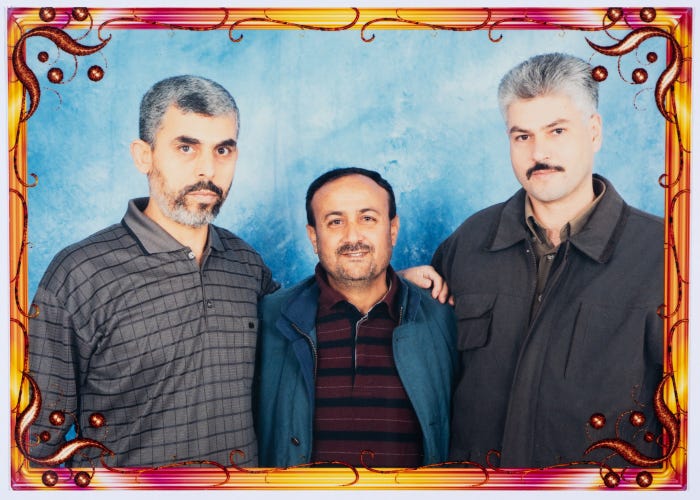
Photograph of Yahya Sinwar (left), Marwan Barghouti (middle), and Abbas al-Sayed in Hadarim Prison (ca. 2000s); The Palestinian Museum Digital Archive
Translator’s note:
In 2010, the Waʿed Association for Prisoners and Freed Prisoners published the book al-Majd (Glory), written by the martyr Yahya al-Sinwar during his years of imprisonment in occupation prisons, in which he reviews the purview of the al-Majd apparatus. As I noted in my article, “The History Behind Hamas’s Intelligence Apparatus and Understanding its Approach to the Abu Shabab Gang and Other Collaborator Networks: On Al-Majd, Al-Mujahidun Al-Filastiniyyun, and Al-Qiwa Al-Tanfîdîyâ”:
According to Mohsen Mohammed Saleh, general manager of the Al-Zaytouna Centre, in late 1982 and early 1983, Sheikh Ahmad Yassin began to prioritize the military efforts of the Palestinian Ikhwan, forming a clandestine committee under his leadership that would be responsible for preparation and military operations. The committee included ‘Abdul-Rahman Tamraz, Ibrahim al-Makadmeh, and Ahmad al-Milh. This committee’s efforts would lay the groundwork for the emergence of two important organizations: i) the Palestinian Mujahidun (viz., al-Mujahidun al-Filastiniyyun) and ii) Al-Da’wah Security Service (viz., Jihaz Amn al-Da‘wa), the predecessor organization to Munadhamat al-Jihad wa al-Da’wah, also known as al-Majd. In April 1983, Yassin requested Tamraz to travel to Jordan in order to request funds for purchasing weapons. There he met Yusuf al-‘Azm, who was at this point the Secretary of the Ikhwan movement and would subsequently become Minister of Social Development; al-‘Azm granted “initial support” to Tamraz. […]
In 1985, Sheikh Ahmed Yassin was released after having spent 11 months in prison, as part of a prisoner exchange between the zionist entity and Ahmed Jibril’s PFLP-General Command that saw 1,150 Palestinian prisoners freed in exchange for three zionist occupation soldiers. […]
It is during this period that, drawing on the extant infrastructure of Al-Da’wah Security Service, Yassin advanced the organization’s intelligence strategies to form the armed organization called al-Majd (or “Glory”), an acronym for Munaẓẓamat al-Jihād wa’l-Daʿwa (“The Organization of Holy War and Preaching”). Due to Yassin’s efforts and the coalescing of the three leading figures of al-Majd—that is, Yahya al-Sinwar, Khaled al-Hindi, and Ruhi Mushtaha—over the course of 1986, many commentators have averred that 1986 marks not only the formation of al-Majd but the beginning of the Palestinian Ikhwan’s intelligence-gathering efforts. The groundwork and infrastructure of Al-Majd had, in fact, been founded several years earlier than 1986—either three years earlier, in 1983, or five years earlier, in 1981. Political scientist Khaled Hroub traces al-Majd’s founding, vis-à-vis Al-Da’wah Security Service, to 1983, writing that ‘Majd [...] in fact had been founded in 1983’ and, from that point, was tasked with ‘liquidating spies and fabricating explosive devices.’ However, according to Mohsen Saleh’s 1992 historical overview of Hamas, ‘[t]he MB’s [viz., Muslim Brotherhood’s] security apparatus in GS [viz., Gaza Strip] (MAJD) was founded in 1981, as part of resistance activities,’ but ‘was rebuilt and expanded in 1985.’ […]
Indeed, although al-Majd’s infrastructure was established prior to Yassin’s imprisonment, his return marked its expansion. This is why 1986 was a pivotal year and the reference point for most commentators (including those who, unfortunately, shirk its precedential history). Headed by Yahya al-Sinwar and Rawhi Mushtaha, the first cell of al-Majd began its operations in 1986 and 1987. It should here also be highlighted that al-Sinwar not only played an important role in al-Majd but was also involved in its predecessor organization, Al-Da’wah Security Service. According to Sinwar’s martyr biography, after Sinwar “was arrested in 1982 and imprisoned for six months in al-Far‘a prison due to his resistance activity,” “[h]e participated in founding the first movement security apparatus (Da‘wa Security) under Sheikh Ahmad Yassin in 1983” and “[i]n 1986, he and others were tasked by Sheikh Ahmad Yassin with forming the Organization of Jihad and Preaching (Majd), where he became one of its most prominent leaders.”[1]
The Jihad and Daʿwa Organization “Majd’s” mission was, in short, to combat agents of the occupation, expose espionage operations against the resistance and Palestinian society, and counter the methods of the occupation’s intelligence apparatus, the Shabak (viz., Shin Bet), including its recruitment of agents. On the one hand, al-Sinwar’s book examines the experience of the al-Majd apparatus, and on the other, it presents an account of the conditions experienced by the Palestinian people during the 1980s and 1990s, the period in which the al-Majd apparatus was formed. Al-Sinwar concluded his book with a series of summaries that included his views on many issues—apparently written at the beginning of the al-Aqsa Intifada (i.e., the Second Intifada)—which reflect his political, ideological, and intellectual outlook. These summaries also convey a general assessment of the conditions experienced by Palestinian society prior to the Intifada. They emphasize the importance of security in the Palestinian people’s liberation struggle and underscore the need for Palestinians, in the resistance and civil society alike, to remain attentive to it. Reading al-Sinwar’s “conclusions,” published initially on the Metras website and now translated into English for the first time[2] leads to a set of fundamental conclusions about al-Sinwar’s thinking. At the heart of his thought is a perspicacious and unflagging interest in all paths of struggle, ranging from throwing stones—which he conceives of as a rudimentary but primary weapon—to armed struggle. In addition, al-Sinwar stresses the importance of criticizing and holding political leaders accountable, expressing great confidence in the Palestinian people and their willingness to sacrifice. Al-Sinwar also repeatedly calls for preparations for a long-term war, presaging Tufan al-Aqsa, and urges that Palestinians not take the putative ideological and political differences and divisions within the zionist occupation’s society seriously. Indeed, al-Sinwar highlights that there are myriad issues fundamental to Palestinian human rights that the various political parties within the zionist entity, be it Ha’Avoda or Likud, refuse to hold differing positions on. Simultaneously, the martyr Abu Ibrahim offers a general assessment of the condition of Palestinian society following the 11 September 2001 attacks in the United States of America. His statements reflect a deep understanding of the regional and international situation and a close monitoring of information and news from within his prison cell. This stands in contrast to those who claim that Palestinian prisoners remain ignorant of outside political states of affairs.
Al-Sinwar also advances a fundamental point concerning the place of “Arab and Islamic peoples” in Abu Ibrahim’s discourse and vision, which he conceives of as “the main source of support for the resistance,” writing that “if they do not step forward to assume this role, then the future of the Palestinian resistance is in grave danger.” This, in turn, reflects the Islamic and internationalist character of al-Sinwar’s worldview. What follows are excerpts from Yahya al-Sinwar’s book, al-Majd (Glory), published in English for the first time. Note that the article has not undergone any editorial intervention and is published in its original form as it was received.
Disclaimer: This translation is provided solely for purposes of independent academic research, analysis, and education within the field of political science. The original text is treated as a primary historical and political source and is presented to facilitate scholarly examination, critical interpretation, and contextual understanding.
Al-Majd (Excerpts)
by Yahya al-Sinwar (Abu Ibrahim), originally published in 2010
Even the most dovish leaders and heads of “Israel,” who are most willing to engage with Palestinian rights according to “Israeli” and Western media portrayals, are not prepared to cross certain red lines that they believe would harm the foundations of “Israel’s” existence and survival. Among those lines are the issue of Jerusalem, the issue of refugees, and the form, powers, and strength of the Palestinian state that may be agreed upon.
The issue of Jerusalem touches on Jewish doctrine in a sensitive way, as the Palestinians want it to, and transferring sovereignty over the Al-Aqsa Mosque to the Palestinians would mean demolishing the foundations and justifications for the establishment of the religious and historical state of “Israel” and would spark internal fighting in “Israel.” Therefore, no one can imagine that any negotiations under the current balance of power could resolve this issue in a way that would satisfy even the majority of those who support the option of negotiations and peace. It could only satisfy a very small handful of people who are willing to sell everything for their own personal interests. The refugee issue, in the opinion of the vast majority of “Israelis,” is of extreme strategic importance to “Israel.” The return of more than a million displaced Palestinians to the borders of the “State of Israel,” in addition to more than a million others within the Green Line who hold “Israeli” citizenship by virtue of their presence within “Israel,” would mean that the Jewish majority in the state would be endangered by Arab population growth, threatening the Jewish character of the state and the establishment of a Palestinian state with unlimited power and authority, especially in the field of armament, which would pose a strategic threat to the very existence and continuity of “Israel.”
Therefore, the vast majority of political leaders in “Israel” are unwilling to break these three lines, not even leftists such as Yossi Sarid. The flexibility that these leaders may show is through attempts to dissolve these issues with superficial solutions that deceive the Palestinians, rather than real solutions, which may be accepted by the more flexible Palestinians and even the most flexible of those who are not prepared to compromise on the minimum requirements at the Palestinian level.
Those who know these facts understand well the reasons behind this dramatic battle and the fierce war raging on Palestinian soil, which today exceeds all reasonable limits, as “Israeli” brutality may increase in a blatant and illogical manner. The terminology that has prevailed in the region over the past three decades has begun to change dramatically. For example, the policy of assassinations has become legitimate and normal at the level of “Israel’s” rulers, which is reflected in global and even Arab reactions. This comes in contrast to the growing and increasingly strategic capabilities of the resistance. The use of F-16 fighter jets to bomb Palestinian areas is nothing but an expression of those terms and standards.
The “Israeli” army and various security agencies are rampaging against a people who are nearly defenseless, except for their faith and some light weapons, and the willingness of their mothers’ dearest ones to blow themselves up in the midst of enemy residential and military gatherings. Aircraft roar in the sky, helicopters fire their missiles morning and evening, bulldozers demolish homes and farms, wreaking havoc and destruction. The Palestinian people stand alone against this blind, crushing machine, unwilling to relinquish their rights. The Arab and Islamic nations, with their numbers, their armies, and their wealth, do nothing, except for a few minor actions.
In light of the global reality and circumstances even before September 11, 2001—and although the situation has become more complicated after that date, even if only temporarily—the current global reality is not in favor of the resistance, if not practically against it. Therefore, the resistance must adapt and prepare itself for a long war, and not raise its ambitions and demands too high at this time. With patience, perseverance, and the ability to communicate, it will, with God’s help, be able to achieve its highest goals, God willing.
The major world powers have never been and will never be on our side or in favor of our rights. Rather, it is more likely that they have been, are now, and will continue to be against us for many more years. What about the fantastical restrictions and suffocation they are imposing, which they planned in relation to a solution with “Israel” in a manner that was unacceptable to large segments of the Palestinian people and the Arab and Islamic nations? The resistance must not bet on any positive positions that will emerge from this at the current stage, as no change in the current state of affairs should be expected. The state of political affairs may indeed further shift if events analogous to those that took place on September 11, 2001 take place,[3] which everyone realizes came as a result of the perpetrators’ convictions concerning the region. There is no doubt that further incidents will take place in one form or another if the negative situation continues, as it will push the citizens of these countries to prioritize their own interests and those of their nation over the interests and security of “Israel.” This may take many years, but I do not believe it will take less than a decade.
International organizations, associations, and institutions are mostly governed by equations of power balances. They are not independent in their work, are not detached from reality, and are governed by those equations and rules. It is not the balance of right and justice that drives them, despite this being their official slogan, but rather the interests of the major powers and equations of balance and interests. The current situation has some positive points, but they are far from achieving the minimum rights of our people. The rejection of proposals and projects calling for the dispatch of protection forces to the Palestinian territories is clear evidence of the meager support for the Palestinian people and the resistance among some institutions, associations, and their affiliated bodies, especially in the field of human rights, such as the International Red Cross, Amnesty International, and other human rights associations. The position of these organizations may become more positive if there is a positive change in the positions of the active forces, as mentioned above.
Arab governments and regimes (despite their varying degrees of readiness and roles) are far from meeting the aspirations and hopes of the Palestinian people or fulfilling their dreams. It is no longer reasonable today for Arab countries to declare war on “Israel” to achieve the minimum Arab and Palestinian dream. Even if war is declared, it will be “Israel” that declares it on one side through its attempts to escape the pressure of the Palestinian resistance, and the rest of the Arab states will most likely remain spectators. Even if the original Arab pride is stirred up in some, they will condemn the “Israeli” attack and demand that the United Nations and the superpowers intervene to stop the aggression.
I believe that the Palestinian resistance should not rely too much on Arab governments and regimes during the current decade, or at least during the first half of it. It can be satisfied with the current reality, with its limited positive points, while trying to develop it as much as possible. It can bet on some preparations here and there to obtain financial support for the Palestinian people to continue their lives so that they can continue the resistance, and achieve some political support by insisting on the legitimacy of the resistance and not labeling it as terrorism, and achieving some international resolutions in favor of the resistance, no matter how simple they may be. The most important and dangerous thing that the Palestinian resistance must aspire to from these regimes is that these regimes turn a blind eye to other types of support provided by peoples or other parties, or that comes to the resistance through their territories, even if the resistance or those who support it must be careful not to undermine the security of these regimes in any way or any of their interests, and limit these types of support to serving the resistance against the occupation.
The Arab and Islamic peoples, their movements, organizations, forces, and various associations play a very important role and are the main source of support for the resistance. If they do not come forward to provide this support, the future of the Palestinian resistance will be in grave danger. It is also necessary that this support be provided in a manner that does not threaten the interests of rulers and regimes and does not conflict with them as much as possible. The role of the peoples and their movements is essentially to form a protective cordon and a lifeline for the resistance. The state of connection, sympathy, and solidarity with the Palestinian people and their resistance, and the expressions of fervor among these peoples, are the main lifeline for the resistance. The revolution of the peoples, their organizations, and their forces to create images of change from these feelings, in a way that does not blatantly conflict with the regimes, makes these regimes and major powers, in their pressure on these regimes, unable to harm the resistance or cut off the air from it and the people. The peoples are able to support the resistance and the Palestinian people in many ways, financially, through the media (and here it is necessary to emphasize the role of free Arab media professionals in recognizing the seriousness of their role in supporting the resistance, which is no less serious than any form of practical resistance in the field), and through security, military, and administrative expertise, and if possible, through manpower.
The Palestinian people have proven that they lack neither conviction nor belief in their rights and the sanctity of their goals, nor a high fighting spirit, nor a willingness to sacrifice, give, and redeem, nor a willingness to endure, suffer, be patient, and persevere. They have proven this scientifically and in the field, and continue to provide evidence and proof every day. However, the Palestinian Arab people are in dire need of a number of sensitive and important things:
· They should not abandon their most dangerous weapon, which they can resort to whenever things get tough, and through which they can resolve many aspects of the conflict: the weapon of stones.
· They must portray and increase their role in monitoring and holding accountable those who come to the fore and advance to leadership and command, and know that they have every right to know the course and details of events, and to be the first and last arbiter in important, sensitive, and fateful issues. They must develop mechanisms that will enable themselves to do so and impose them on everyone.
· The importance of their role in preventing internal fighting and strife or the violation of national constants is particularly evident.
· Palestinian society must take a more prominent role in guiding the resistance and enriching its methods and means of action through proposals, innovation, and development. Here, it is necessary to emphasize the need for every individual to constantly think, especially in their field of work and specialization, about how they can be of use to the resistance. Chemists must think about how they can use chemistry for the benefit of the resistance, as must physicists, doctors, architects, mechanics, civil engineers, geologists, computer experts, Internet experts, drivers, blacksmiths, carpenters, construction workers, and even kindergarten teachers. A child may instinctively do something that is necessary for the resistance, and the Palestinian people must find the mechanisms and means to organize and utilize this effectively.
· Because our topic here specifically concerns security, our people must become more prepared to act against security breaches and infiltrations, especially against the phenomenon of collaborators.
· Every citizen must become an informant and feel a special responsibility to investigate, monitor, and report any information about suspects or collaborators to the relevant resistance authorities.
· One must develop his or her readiness to deal with these phenomena, especially when they affect relatives, family, and loved ones. Each individual must take the initiative to deal with what immediately concerns them before an individual is forced into excision from Palestinian society or before the foul odor of collaborationism spreads within his social circle. This occurs as, first and foremost, a matter of despair and the family’s role is very important in preventing this matter. The ability of the family and relatives to discover any imbalance within it (i.e., among its members) is much greater than that of others. The family members must hasten to deal with this and solve it from the outset, before collaboration spreads and causes problems and pain that may extend for generations, destroying the family’s reputation and social standing.
· As for the resistance, its role is significant, and we will discuss it later, God willing, as this summary report is specifically dedicated to it. The Palestinian citizen plays a significant and important role, and he has never lacked preparedness. Fares Odeh, who confronted an “Israeli” tank with a stone, proved that he was willing to pay the price for his steadfastness on the path of resistance.[4] The mother who ululates when she receives the news of the martyrdom of her son, daughter, or husband, with tears flooding her eyes, and the hundreds of martyrs, thousands of martyrs, and tens of thousands of prisoners are the best proof of this. However, Palestinian citizens need more awareness, understanding, culture, and knowledge. Their role must be to monitor those who run things, to be willing to sacrifice and give of themselves, and to love martyrdom. Nothing should prevent them from understanding exactly what is happening, where it is leading, and what price our people will pay for their efforts, sacrifices, and martyrdom.
· At first glance, it may seem that we have strayed far from our main topic, but the reader has not forgotten, and must not forget, that our main topic is our war in Palestine, face to face with the “Israeli” General Intelligence Service, the Shabak. Indeed, the war is taking place in Palestine, which is the center and focus of attention. This study focuses on the Shabak as the spearhead of the occupation in its war against the Palestinian resistance. Discussing the methods of confronting the Shabak’s work, means, and methods is the easiest thing to do, and it is an important element among a number of important and necessary elements. This element alone (i.e., countering the Shabak/Shin Bet’s methods) will not be effective in the war, just as none of the other elements alone will be effective. It is important to emphasize that neglecting this particular element will cause a major imbalance in the work of the resistance, which will necessarily mean that the resistance will incur many times more than what is required to achieve its goals.
· The war currently raging in Palestine is like two people biting each other’s fingers (with a difference in the analogy), and victory will go to whoever endures enough such that their opponent scream first. The point here is that both sides are suffering and in pain. The Palestinian people and their resistance are suffering and in pain, and “Israel” and its apparatus and army are suffering and in pain. On the one hand, the winner will be the one who is more patient. On the other hand, the winner will also be the one who is able to inflict the greatest pain on his opponent (under the rules of the current game), forcing him to cry out or otherwise announcing surrender.
· A more dangerous scenario is the ability of one side or the other to destroy most of the other’s apparatus in its attempt to inflict pain on it. This is where the Shabak comes in to reduce the pain and suffering of “Israel,” its forces, and its people.
· “Israeli” Minister Benjamin Eliezer[5] has stated more than once in the “Israeli” media that only 15% of resistance operations are successful, while 85% are thwarted or fail.
· “Israeli” Prime Minister Ariel Sharon also stated in an interview with “Israel’s” Channel 2 television that only 20% are successful, while 80% of resistance actions are thwarted and fail. The practical translation of this is that if it takes a thousand Palestinian martyrs to force “Israel” to cry out first or make concessions, then according to the best figures for the resistance, it must pay at least five times that number as long as the equation continues at this ratio.
· Frustrating 85% of the resistance’s efforts, or even 80%, the Shabak alone accounts for at least 50% of this through the use of its methods, which have already been explained and detailed, while the other part of this failure and frustration falls directly on the resistance (and to confirm and clarify, the first 50% is also indirectly the responsibility of the resistance). Hence the importance of addressing the causes of this direct failure and frustration and adopting mechanisms and means to avoid it. We will then devote more space to suggestions that we believe will reduce (50%) of the frustration and failure caused by the Shabak through its various methods and means.
[1] Mujamma Haraket, “The History Behind Hamas’s Intelligence Apparatus and Understanding its Approach to the Abu Shabab Gang and Other Collaborator Networks: On Al-Majd, Al-Mujahidun Al-Filastiniyyun, and Al-Qiwa Al-Tanfîdîyâ,” Substack, 27 September 2025; retrieved online (17 January 2026): https://mujammaharaket.substack.com/p/the-history-behind-hamass-intelligence#_ftn26 . For more on al-Majd’s history, see: Beverley Milton-Edwards and Stephen Farrell, Hamas (Cambridge: Polity, 2010), p. 116; Aql Salah, “The Al-Aqsa Flood and the History of Hamas’s Struggle Performance” [طوفان الأقصى وتاريخ الأداء الكفاحي الحركة حماس], Al-Mustaqbal Al-Arabi, Is. 553, 2025, pp. 140-141; Al-Jazeera Arabic’s 18 October 2024 biography of al-Sinwar, https://tinyurl.com/47zhya3b (Accessed 20 September 2025); Asharq Al-Awsat Newspaper’s article on Mushtaha, https://tinyurl.com/33azbefh (Accessed 20 September 2025).
[2] Hassan Kamal, “For the first time online: the article ‘Summaries of al-Majd’ by Al-Sinwar,” Metras, 24 February 2025; retrieved online (17 January 2026): https://shorturl.at/3F3xP ; Khaled Hroub, Hamas: Political Thought and Practice (Beirut: Institute of Palestine Studies, 2000), p. 40; Ziad Abu-Amr, in R. Scott Appleby (Ed.), “Shayk Ahmad Yasin and the Origins of Hamas,” Spokesmen for the Despised: Fundamentalist Leaders of the Middle East (Chicago: University of Chicago Press, 1997), p. 239; Mohsen Saleh, “The Islamic Resistance Movement (Hamas): An Overview of Its Experience & History 1987–2005” in Mohsen Saleh (Ed.), Islamic Resistance Movement (Hamas) Studies of Thought & Experience (Beirut: Al-Zaytouna Centre for Studies & Consultation, 1992), p. 33; Tarek Hamoud, Socializing Hamas: Evaluating the Structural Political Developments in the Islamic Palestinian Resistance Movement as a Ruling Authority Between 2006-2017, PhD thesis, University of Exeter, January 2023, p. 71.
[3] Translator’s note: as indicated by his lexical shift, Al-Sinwar seems to have in analogous states of affairs within the context of the zionist occupation rather than any other nation.
[4] Translator’s note: Faris Odeh (b. 3 December 1985 – d. 8 November 2000) was a Palestinian youth from the zionist-occupied Gaza Strip who became widely recognized as a symbol of Palestinian resistance after a photograph captured him hurling a stone at a zionist occupation tank during the Second Intifada. In November 2000, Odeh was shot and killed by zionist occupation soldiers near the Karni Crossing while he was engaged in stone-throwing.
[5] Translator’s note: Al-Sinwar here refers to to zionist occupation army minister Benjamin Eliezer, who was the military’s army minister between 2001 and 2002.
I cannot tell you how much I appreciate your scholarly contributions to the Palestinian Resistance Narrative and History, Mujamma! Your work will stand the test of the ages. I have been studying, collecting information, and commenting on the life of Yahya Sinwar for the last 6 months. I don’t think people in the USA and Europe have any idea how brilliant and compassionate a man he was. The more I read, the more awed I become by his life’s work. Not only the work of maintaining the dignity and integrity of the Palestinian people, but the work of demonstrating for others effective ways to overcome the evils of colonial oppression. This article was excellent, Mujamma. I look forward to reading and sharing more of your wisdom with others. Peace always to you.
I only learned of him the day he died and now I miss him